How often should hotels in Houston get commercial carpet cleaning? Lobby and high-traffic corridor carpet needs professional cleaning every 30 to 60 days. Guest rooms need it every 6 to 12 months. Banquet and conference carpet needs it every 60 to 90 days, or right after a large event. Houston’s humidity makes this schedule tighter than in drier markets.
Carpet cleaning is not the same job once you’re running a hotel. A lobby carpet takes more foot traffic in one weekend than a home living room sees in a year. That changes how often it needs care and who you should trust with the work. Rolling suitcases. Wet shoes. Banquet spills. Daily housekeeping carts. All of it wears down fibers fast, in ways no homeowner ever deals with. That’s why hotel carpet cleaning Houston properties need a different schedule, method, and vendor standard than a normal home visit.
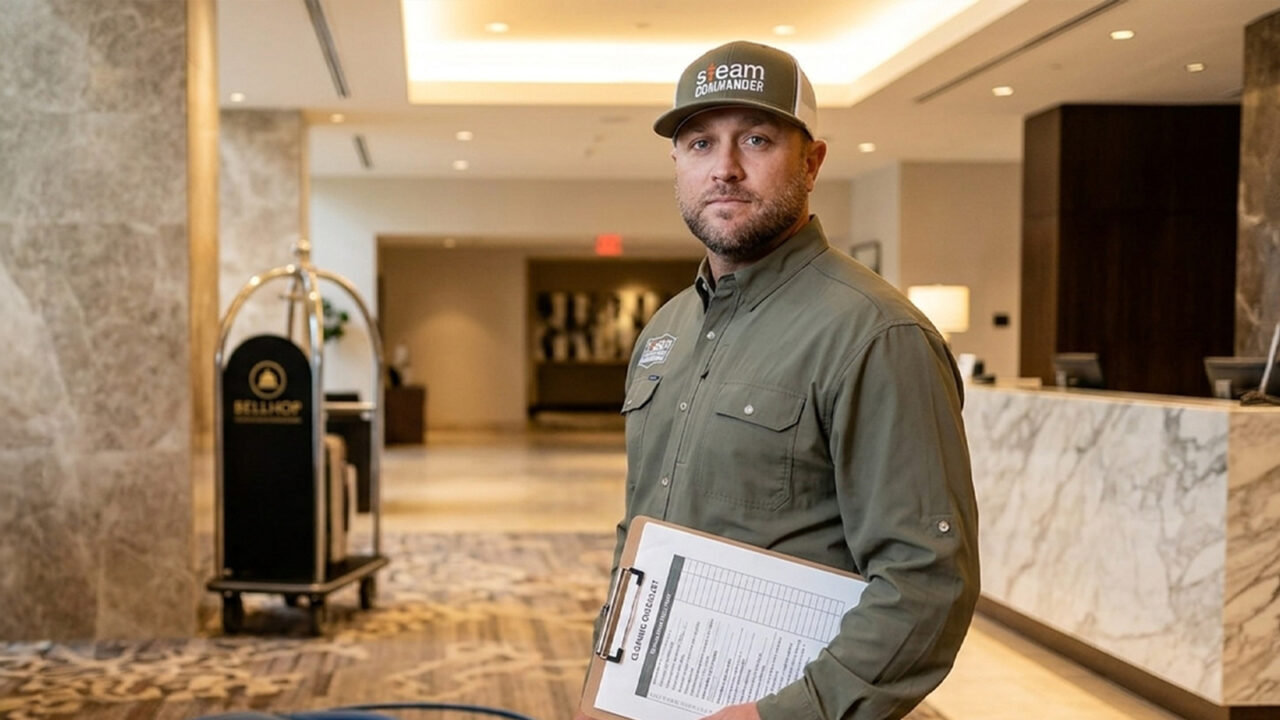
Facilities managers juggle brand audits, guest complaints, and budget approvals. They need a documented, repeatable system, not a one-time deep clean. Our commercial carpet cleaning service is built for that reality: recurring contracts, moisture documentation, and technicians who know what a Marriott or Hilton quality auditor actually looks for when they walk your lobby.
We tailor every contract to the property’s traffic patterns, fiber type, and brand requirements instead of using one plan for every property, offering a level of customization most one-off cleaning crews simply don’t provide.
Key Takeaways
- High-traffic zones like lobbies and hallways need professional cleaning every 30 to 60 days. Guest rooms need it every 6 to 12 months. Banquet and conference carpet needs attention every 60 to 90 days, or right after a big event.
- Hot water extraction is the industry standard for commercial carpet fibers like nylon and olefin. But Houston’s humidity makes low-moisture encapsulation a smart choice for faster turnaround in rooms that are still in use.
- Hotel-scale cleaning contracts are priced by square footage and cleaning frequency, not a flat rate per room. Plan for that pricing structure as you head into your 2026 vendor talks.
- Brand audits from Marriott, Hilton, and IHG expect documented cleaning logs. A carpet that just looks clean on the day of the visit isn’t enough.
- Check any vendor for IICRC certification, active insurance, and real hospitality references before you sign anything.
Why Is Hotel Carpet Cleaning Different From Residential or Office Cleaning?
A home carpet gets walked on by a handful of people in house shoes. A hotel lobby carpet takes in hundreds of guests a week. Many drag luggage straight from the airport or a rainy parking lot. That volume changes how often the floor needs attention. It also changes how much dirt gets ground into the fibers between cleanings. Properties near Bush Intercontinental, the Energy Corridor, and the Galleria see especially fast guest turnover. Carpet wear speeds up in exactly the spaces guests judge first.
Guest Perception and Brand Audit Stakes
A stained or musty carpet hurts a hotel far more than a dusty carpet hurts a home. A visible stain in the lobby can undo weeks of solid housekeeping in a guest’s mind. Guests write reviews about it. Brand auditors score it. And a facility manager who can’t explain the last cleaning date to ownership has a real liability problem, not just an appearance problem. Professional carpet cleaning at hotel scale is risk management, not just housekeeping. It directly protects guest satisfaction scores that brands track closely, and it signals a level of professionalism that guests and auditors both notice immediately. A property that can point to a recent carpet clean on record, instead of a vague memory of “sometime last quarter,” walks into an audit with far more confidence. If you’re not sure where your property currently stands, a quick walkthrough is usually enough to tell you.
How Often Should Hotel Carpets Be Professionally Cleaned?
Different zones wear out at different speeds. One cleaning schedule for the whole property doesn’t work the way it might in a house.
| Zone | Recommended Frequency |
| Lobby / high-traffic corridors | Every 30-60 days |
| Guest rooms | Every 6-12 months |
| Banquet / conference carpet | Every 60-90 days or post-event |
| Elevator landings / stairwells | Every 30-45 days |
Sticking to a documented rotation across these spaces sets apart a facility with a real maintenance plan from one that just spot-cleans whenever something looks bad. Treat this table as a baseline, not a fixed rule. Properties with heavier group traffic often need tighter windows than this. Scheduling each carpet clean around real occupancy data works better than guessing at a calendar date.
What Is the Best Method for Cleaning Commercial Hotel Carpets?
The right cleaning method depends on the fiber, the traffic level, and how fast the space needs to reopen to guests.
Hot Water Extraction: The Deep-Clean Standard
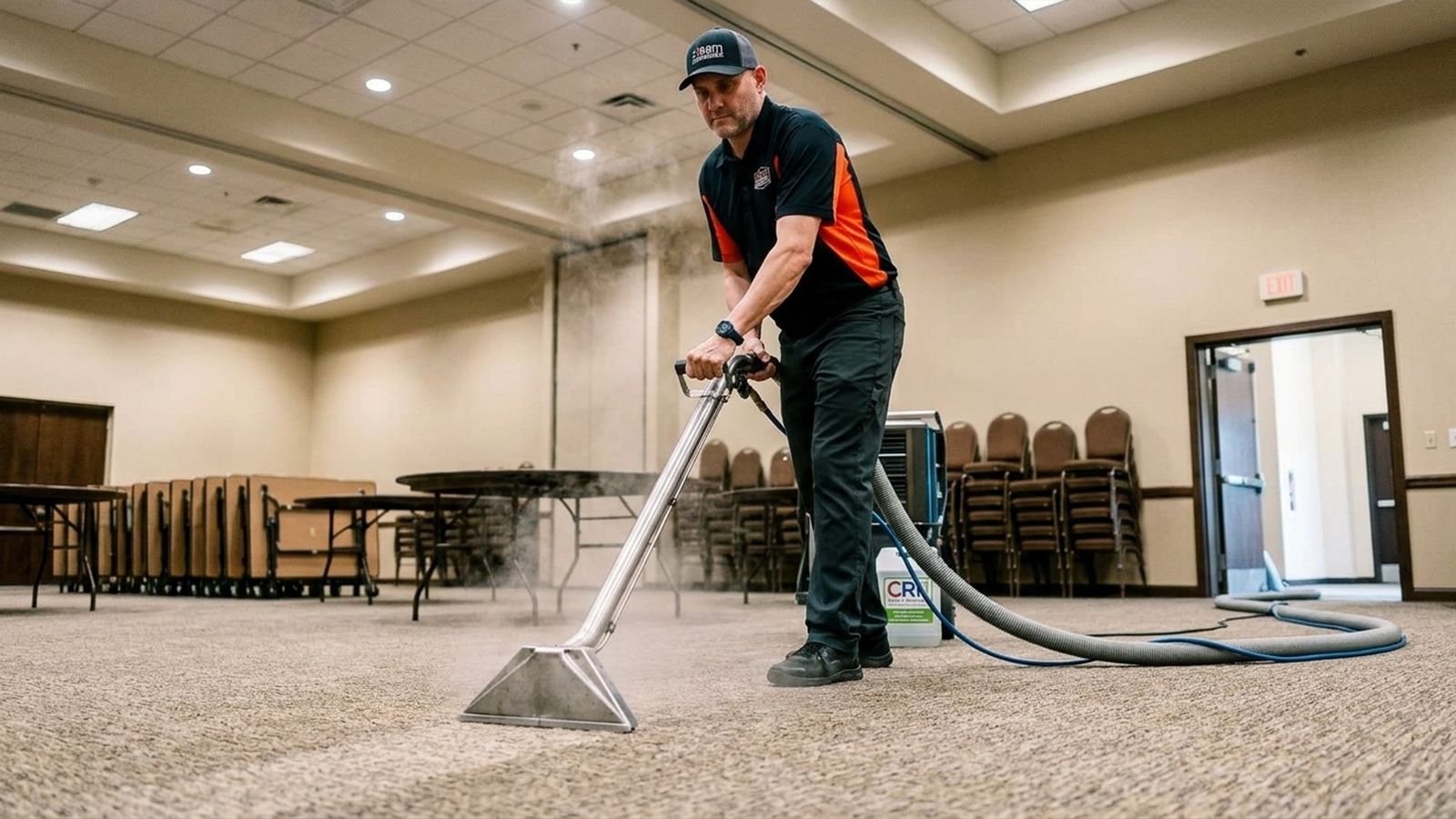
Hot water extraction, often called steam cleaning, is the method recommended under the IICRC S001 standard. It reaches embedded dirt, allergens, and pet dander that surface cleaning misses. It works especially well on the nylon and olefin fibers most hotels use, since those fibers handle more moisture and scrubbing without breaking down. This is the method we use for scheduled deep cleans. We run commercial-grade truck-mounted extraction equipment with cleaning solutions rated under the CRI Seal of Approval program. We also adjust solution strength and dwell time to fit each property’s fiber type and traffic level. This gives a comprehensive approach that covers every zone of the property, not just the areas guests see first.
Low-Moisture Encapsulation for Fast Turnaround
Encapsulation uses much less water and dries much faster. That makes it a strong choice for guest-room turnovers, where housekeeping can’t afford to keep a room out of service for a full day. It doesn’t pull dirt as deep as extraction, though. Most hotels rotate it between full extraction cycles instead of relying on it alone. They use each carpet clean cycle to decide which method fits the room’s turnaround needs.
Bonnet Cleaning: Surface Refresh Only
Bonnet cleaning spins an absorbent pad across the carpet surface to lift visible dirt fast. It works fine as a quick refresh between deeper cleans. But it doesn’t remove ground-in stains or deep dirt. Treating it as a stand-alone method leads to carpet that looks clean on top while breaking down underneath.
Houston’s humidity averages 75 percent and can climb toward 90 percent in early morning hours. This is a challenge shared by many coastal Texas cities. That makes drying time a real factor in choosing a method. Wet extraction paired with weak airflow or a weak HVAC dehumidifier can trap moisture in the pad. That creates a mold risk, exactly what low-moisture methods are built to avoid.
How Long Does Hotel Carpet Take to Dry After Cleaning?
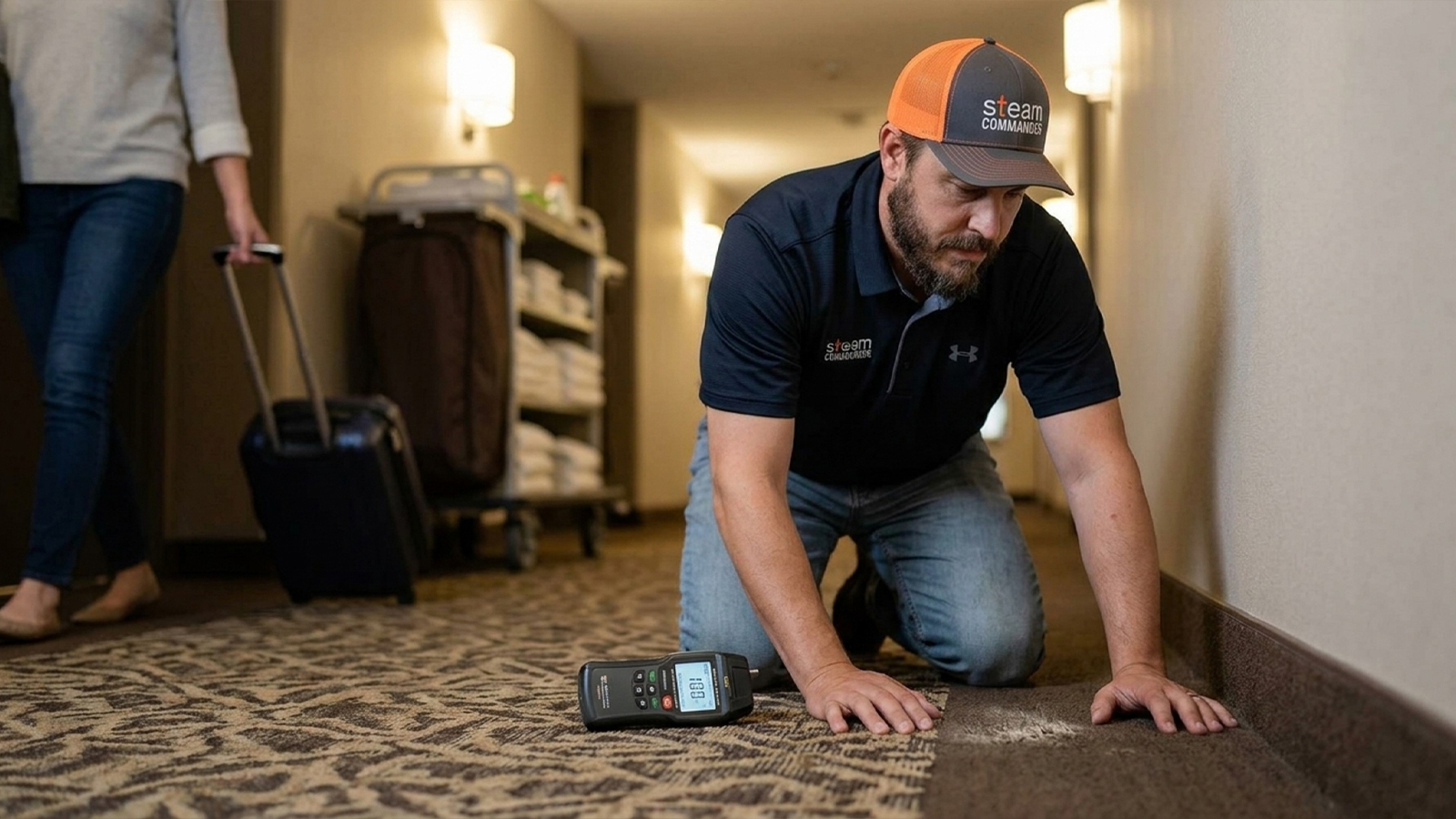
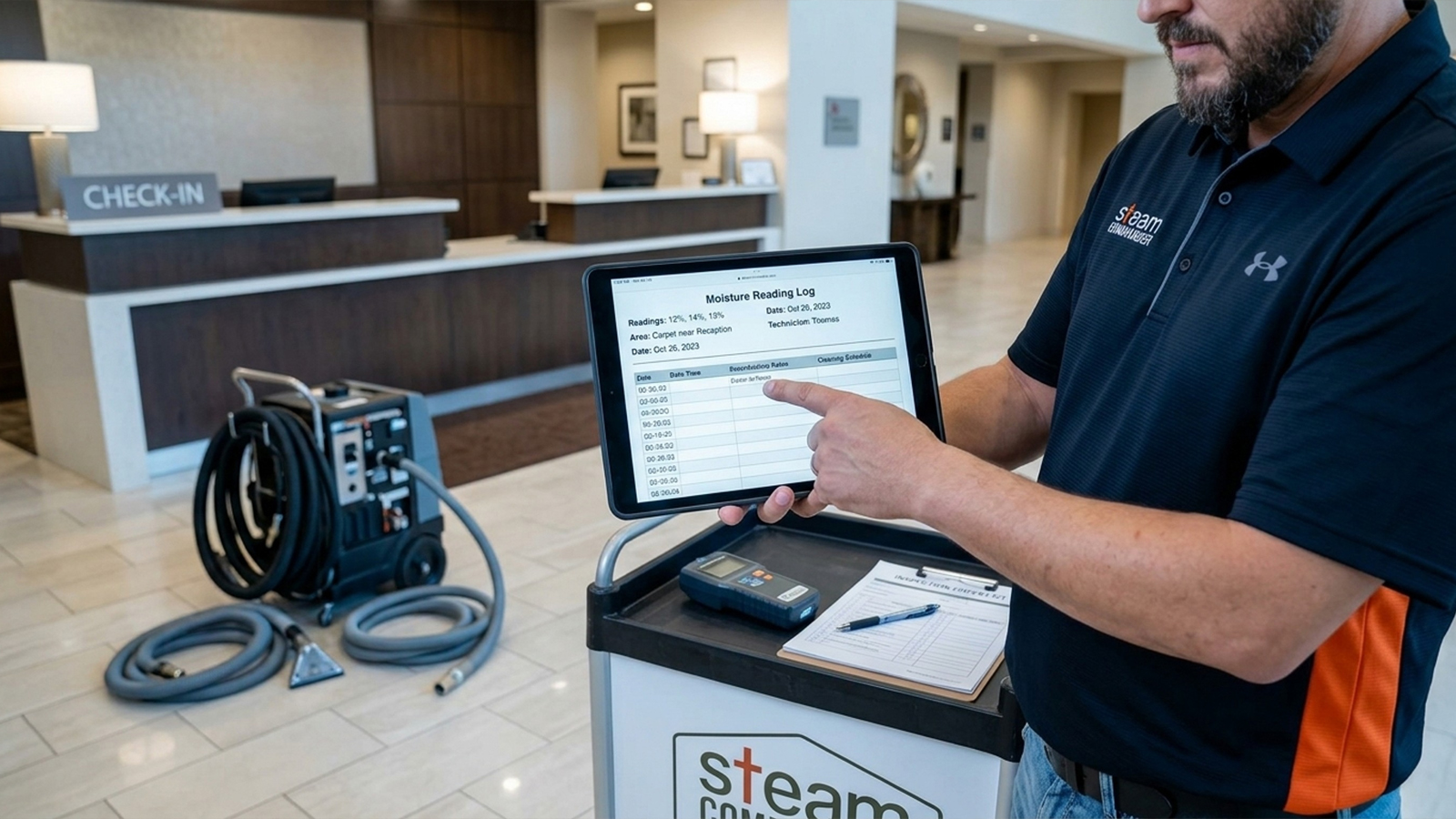
Hotel carpet usually dries within 4 to 8 hours after hot water extraction, if paired with good airflow and dehumidification. It can dry in as little as 1 to 2 hours with low-moisture encapsulation. Houston’s humidity can stretch that window. That’s why moisture meter readings, not a visual guess, should confirm a carpet is safe for guest traffic again.
What Carpet Cleaning Standards Do Hotel Brands Require for Inspections?
Passing a brand audit isn’t just about how the carpet looks the morning the inspector walks in. It’s about whether you can back it up with paperwork.
What Brand Auditors Actually Check
Marriott, Hilton, and IHG quality programs score housekeeping and facility appearance as part of their inspections. Auditors increasingly expect documented cleaning logs, not just a clean-looking carpet on inspection day. A facility manager who can hand over dated service records, moisture readings, and a vendor’s IICRC certification is in a much stronger spot than one relying on memory.
Red Flags to Avoid Before You Hire a Commercial Vendor
After every major flood event, Houston’s market sees a wave of unlicensed, uninsured contractors chasing storm and water damage restoration work across Texas. Some advertise carpet cleaning on the side without real credentials. They offer rock-bottom rates that rarely hold up once the job starts. Before you hire anyone for a hotel-scale contract, watch for:
- No proof of active IICRC certification
- No documented liability insurance
- No references from other hospitality clients
- Vague, undocumented pricing with no written scope of work
- No attention to detail during the walkthrough or proposal process
A vendor who can’t answer basic questions about method choice or drying steps during the first walkthrough is not someone you want in charge of a guest-facing floor. If a vendor hesitates on any of these points, that’s worth noting before you sign anything.
Can Hotels Stay Open During Commercial Carpet Cleaning?
Yes. Hotels can stay fully open during commercial carpet cleaning through section rotation and overnight or early-morning service windows. Fast-drying methods like encapsulation also help keep guest rooms available. Working with a vendor who plans around your occupancy calendar, rather than asking you to work around theirs, keeps disruption to a minimum.
How Much Does Commercial Carpet Cleaning Cost for a Hotel?
Hotel-scale pricing is built around square footage, frequency contracts, and add-on services like tile and grout in lobby bathrooms. It’s not a flat per-room number. A property that signs a recurring contract instead of calling for one-off service usually locks in better, more competitive pricing over the life of the agreement. It also avoids the budget swings that make ownership nervous during review season. This matters most to business owners managing multiple properties on tight margins.
One Cypress-area extended-stay property we service switched from one-off invoices to a quarterly contract. This happened after repeated guest complaints about lobby odor and a lingering carpet stain near the entrance. Within two cleaning cycles, guest complaints tied to that specific issue dropped to zero. Overall customer satisfaction scores for the property improved too. The client now uses our dated service logs directly in its brand audit file. Its regional manager points to the switch as a model other properties in the portfolio are now following, citing the steady carpet clean results as proof the new contract structure was worth it.
If you manage more than one property and want to know what a similar contract structure might look like for your portfolio, a short call is usually enough to sketch out a plan. Reach us at (832) 813-2175 whenever it’s convenient, or leave your phone number with our office and a member of our commercial team will call you back to schedule a walkthrough.
Conclusion: Schedule Your Commercial Carpet Assessment in Houston, TX
Hotel carpet cleaning is a service built on documentation and credentials, not something you shop for by price alone. The properties that pass brand audits without a scramble are the ones working with a licensed, IICRC-certified cleaning service, one that shows up on schedule, logs every visit, and can produce proof of insurance and real hospitality references without hesitation. That’s the kind of vendor relationship you stop having to manage and start being able to trust. If your property has an audit coming up, a budget line to justify, or just a lobby carpet that’s overdue, feel free to call (832) 813-2175 and ask for a commercial account assessment. No contract, no pressure, just a walkthrough and a plan built around your property’s zones, fibers, and brand requirements.
FAQ
How often should hotel carpets be professionally cleaned?
Hotel carpets should follow a zone-based schedule, not one blanket date for the whole property. Lobby and corridor carpet needs professional cleaning every 30 to 60 days. Guest rooms need it every 6 to 12 months. Banquet or conference carpet needs it every 60 to 90 days, or after major events. A documented schedule like this is exactly what a brand auditor wants to see on file. It also works as a practical guideline for any facilities team managing multiple properties across Texas.
What is the best method for cleaning commercial hotel carpets?
Hot water extraction is generally the best method for commercial hotel carpet. It reaches embedded dirt in nylon and olefin fibers under the IICRC S001 standard. Low-moisture encapsulation works as a fast-turnaround option for guest rooms still in use. The right choice depends on fiber type and how quickly the space needs to reopen.
How much does commercial carpet cleaning cost for a hotel?
Commercial carpet cleaning pricing for hotels is based on total square footage and cleaning frequency, not a flat per-room rate. A recurring contract usually costs less over time than repeated one-off calls. To get an accurate number, you need a walkthrough-based quote from a licensed commercial vendor, not a phone estimate. Many business owners find that scheduling an initial appointment for a walkthrough is the fastest way to get a firm number.
What carpet cleaning standards do hotel brands require for inspections?
Marriott, Hilton, and IHG brand audits require both a clean look and documented cleaning logs as proof of a maintained program. A vendor who provides dated service records and moisture readings protects a facility manager during a surprise inspection. Appearance alone is no longer enough.
Can hotels stay open during commercial carpet cleaning?
Yes. Hotels can stay fully open during commercial carpet cleaning through section rotation and overnight or early-morning service windows. Fast-drying methods like encapsulation also help keep guest rooms available. Scheduling around occupancy is a core skill of an experienced commercial vendor. Setting the right appointment window is often the key to keeping disruption small.
How long does hotel carpet take to dry after cleaning?
Hotel carpet dries within 4 to 8 hours after hot water extraction with good airflow, or 1 to 2 hours with low-moisture encapsulation. Houston’s humidity can stretch either window. A moisture meter check, not a visual check, should confirm a space is safe to reopen.
What certifications should a commercial carpet cleaning vendor have for a hotel contract?
A commercial vendor should carry active IICRC certification, proof of liability insurance, and equipment rated under the CRI Seal of Approval program. Houston’s post-storm market has plenty of unlicensed operators. That makes checking credentials a must before you sign any contract.
Does Steam Commander service hotels outside Houston, like Cypress or Tomball?
We service hotel and hospitality accounts across Cypress, Tomball, Katy, Spring, and the greater Houston area, with contracts built around each property’s traffic and layout. Our work goes beyond carpet cleaning alone. We offer a full service lineup for hospitality clients throughout the region, including tile, grout, and upholstery cleaning for lobby furniture, giving properties one vendor instead of several. Call us to schedule a property-specific assessment instead of assuming a generic quote will fit.