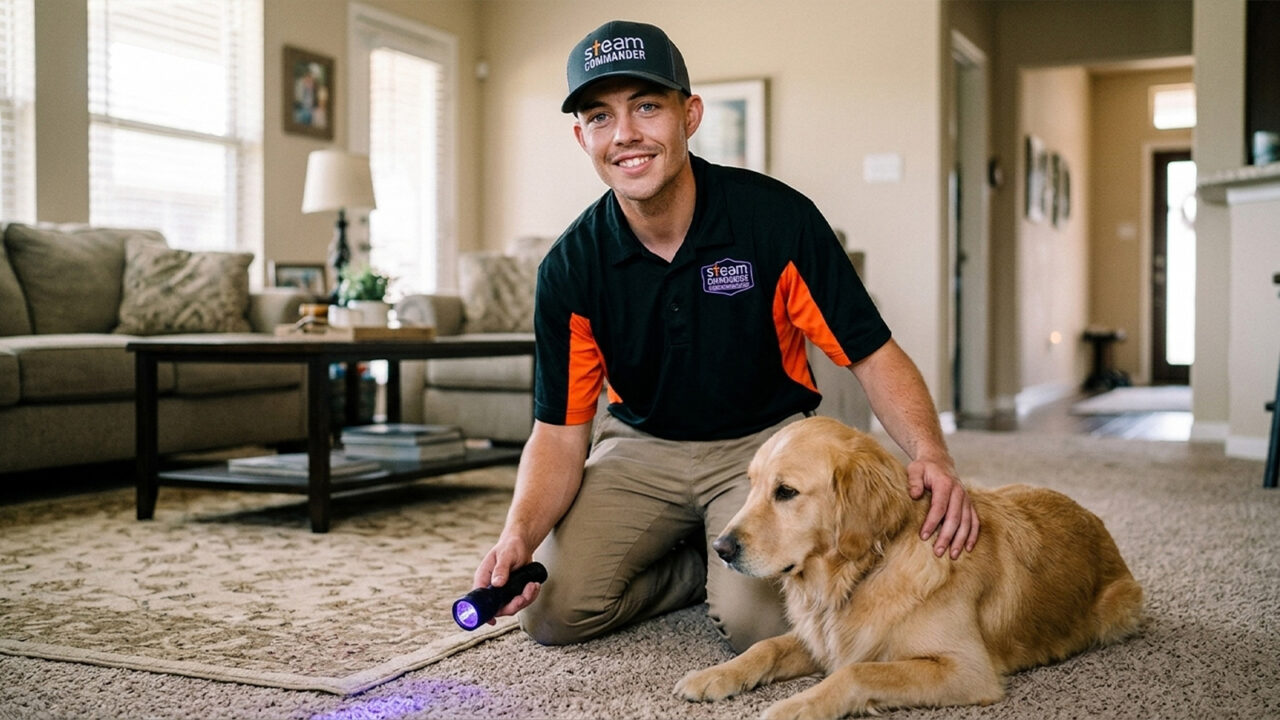
The smell came back, and that is not your fault. Pet urine smell comes back because the urine soaked past the carpet fibers into the pad and subfloor, and the uric acid crystals left behind wake up whenever humidity rewets them. Most professional carpet cleaning stops too shallow to reach that depth, so here is how to fix it at the source.
Key Takeaways
- Urine reaches the pad and subfloor, and uric acid crystals stay behind after surface cleaning.
- Houston-area humidity of 75 to 90 percent rewets those crystals, so the urine odor returns on muggy days.
- Heat can set urine proteins into synthetic fibers, and masking sprays only cover the smell.
- The real fix is UV and moisture mapping, then enzymatic treatment and subsurface extraction at pad depth.
- Pad runs roughly $0.85 to $1.50 per square foot, while a subsurface flush runs roughly $250 to $600 per room.
Why Does My Carpet Still Smell Like Pet Urine After Professional Cleaning? The Five Root Causes
This isn’t bad luck. It’s chemistry. Here are the five reasons the smell keeps coming back, plus a quick check for each.
Urine Soaks Into the Pad and Subfloor
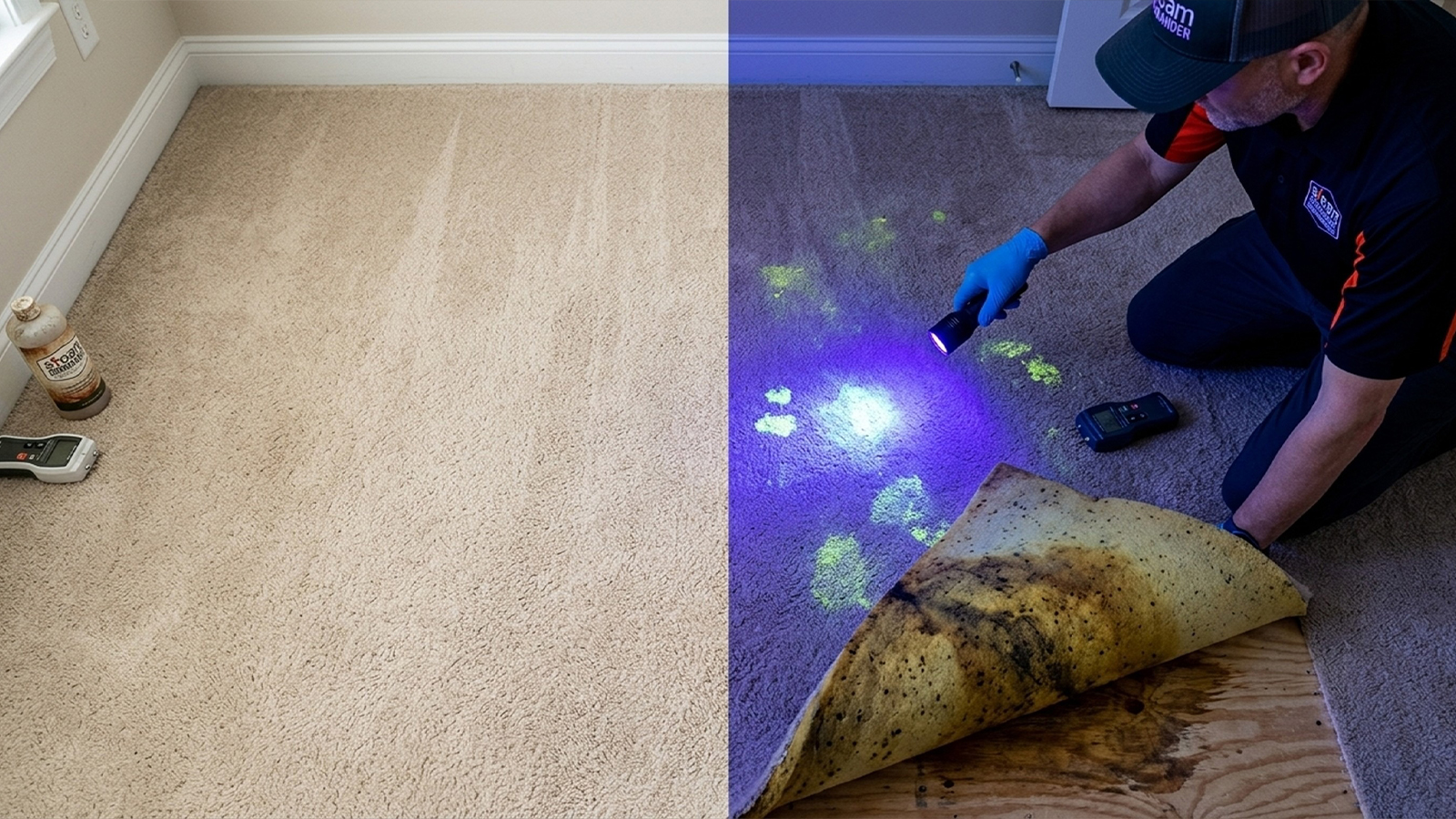
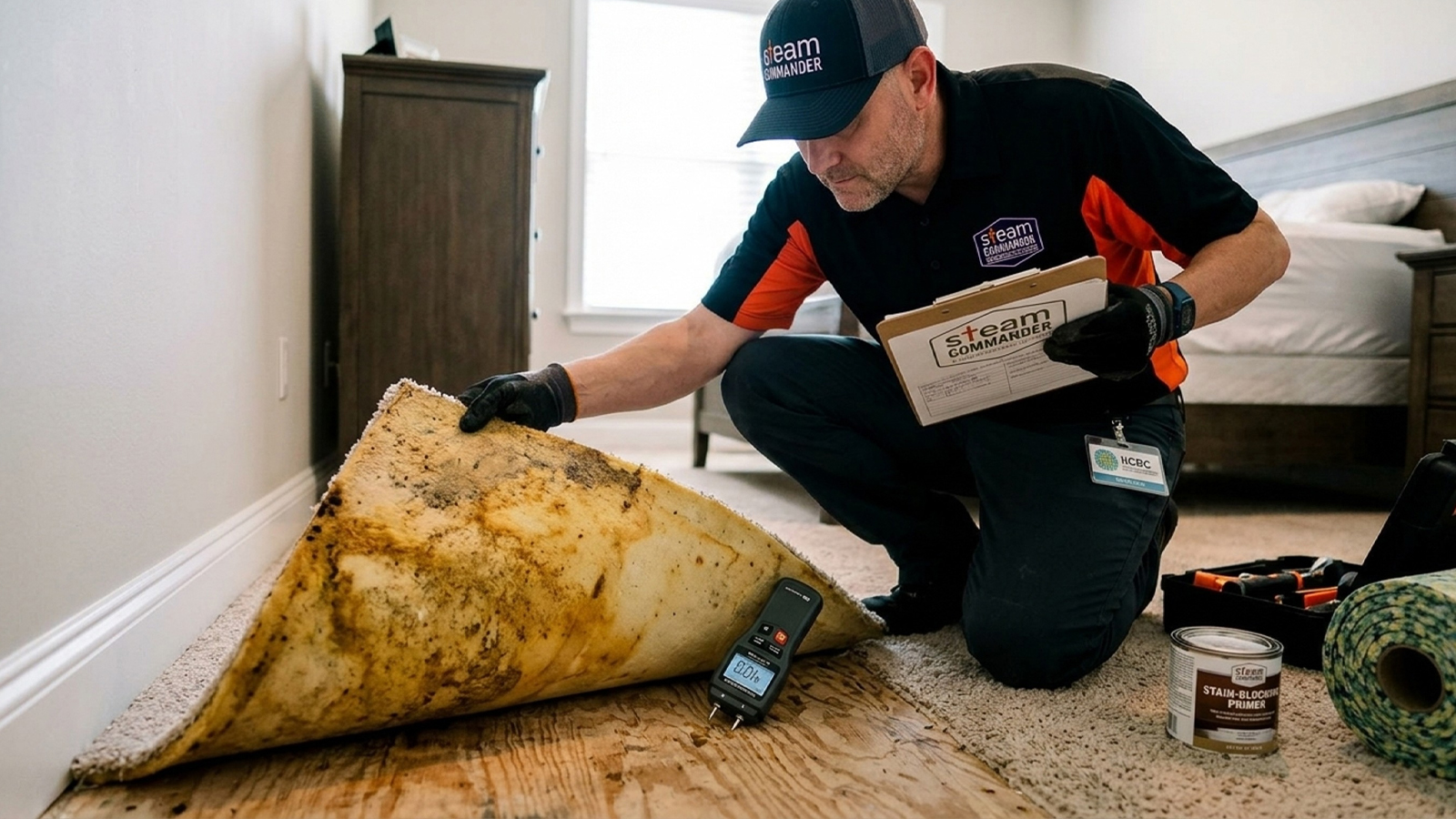
One dog accident can run about eight ounces. That much liquid won’t stay in a one-inch spot. It passes through the carpet fibers, soaks the pad, and can reach the plywood or concrete slab below. Clean only the top and the pool underneath stays untouched. A surface stain that fades doesn’t mean the source is gone.
Uric Acid Crystals Are Insoluble and Reactivate in Humidity
Dried urine leaves behind uric acid crystals. Plain water can’t dissolve them, so ordinary rinsing leaves them right where they are. When humid air or fresh moisture touches them, they release odor again. Wicking adds a second problem. Wet cleaning can moisten the pad and carry salts up to the fiber tips, which is why the smell can seem worse right after cleaning.
Surface-Only or Shallow Cleaning Leaves the Source Behind
Standard cleaning treats the top of the carpet. If the machine never reaches pad depth, the source stays put. The carpet looks clean. The pad stays contaminated, which is why a carpet cleaned only at the surface can still smell like urine a week later.
If this sounds like your home, you’re in good company. Many Cypress families call us after a second or third cleaning that didn’t hold. That usually points to depth, not effort, and it’s fixable.
Alkaline or Masking Chemistry and Heat Can Set the Smell
Does steam cleaning set pet urine smell into carpet? It can, if heat hits untreated urine. Heat can bond proteins to synthetic fibers and lock the smell in. Perfumed sprays and many cleaning products only cover the odor for a while. Alkaline solutions can even feed the problem instead of breaking it down.
Repeat Marking Over Old Spots
Pets return to places that already smell like urine. If the first spot was never fully treated, the cycle repeats, and each layer adds more contamination.
Quick checks that point to pad-level trouble:
- The smell is strongest on humid days.
- It returns within days of cleaning.
- It stays concentrated in one spot.
If two or more match, an inspection will show how deep it goes.
Why Do Houston and Cypress Homes Have It Worse?
Houston-area humidity often sits between 75 and 90 percent. Many Cypress homes sit on slab foundations, so the pad rests on porous concrete that holds moisture. Then the HVAC cycles on and off, indoor humidity rises and falls, and the crystals get rewet again and again. That’s why the carpet smell often spikes on summer afternoons.
How Do I Find Old Pet Urine Spots in Carpet and Map the Real Source?
You can’t treat what you can’t find. Old urine spots often leave no visible stain, so you need the right tools.
Use a 365nm UV Blacklight in a Dark Room
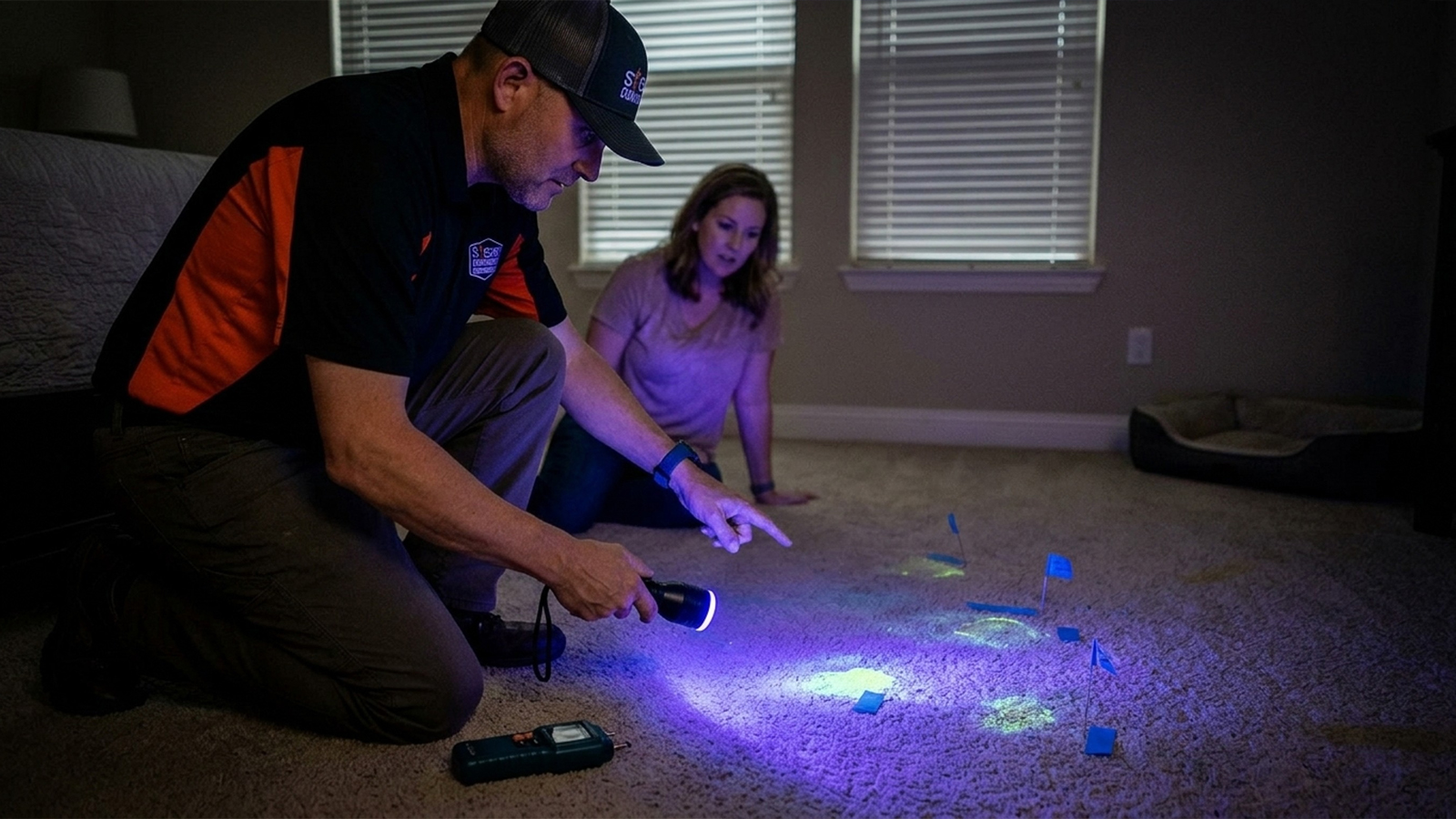
Close the blinds and turn off every light. A 365nm UV blacklight makes old urine glow yellow-green, while a 395nm light is weaker on old urine stains. Sweep slowly at a low angle. Mark each glowing spot with painter’s tape before you treat anything.
Confirm With a Moisture Meter, Floor-Level Sniff Tests, and Edge Checks
A penetrating moisture meter finds damp pad zones, and a thermo-hygrometer shows the humidity that wakes the crystals. Next, kneel and sniff at floor level, ideally on a humid day. Check baseboards, corners, and furniture legs. Urine wicks sideways along edges, and pets mark in favorite places.
What UV Light Cannot Tell You
UV shows organic residue, not odor strength. Spilled food and some cleaning solution can glow too. That’s why we pair UV with moisture readings and show you both. We mark every spot, record the readings, and review them with you before treatment begins. If you’d rather not crawl around your living room with a flashlight, you can ask us to do the mapping and walk you through what we find. There’s no pressure to book anything beyond that.
What Neutralizes Dog or Cat Urine Odor in Carpet Permanently? The Source-Level Removal Process
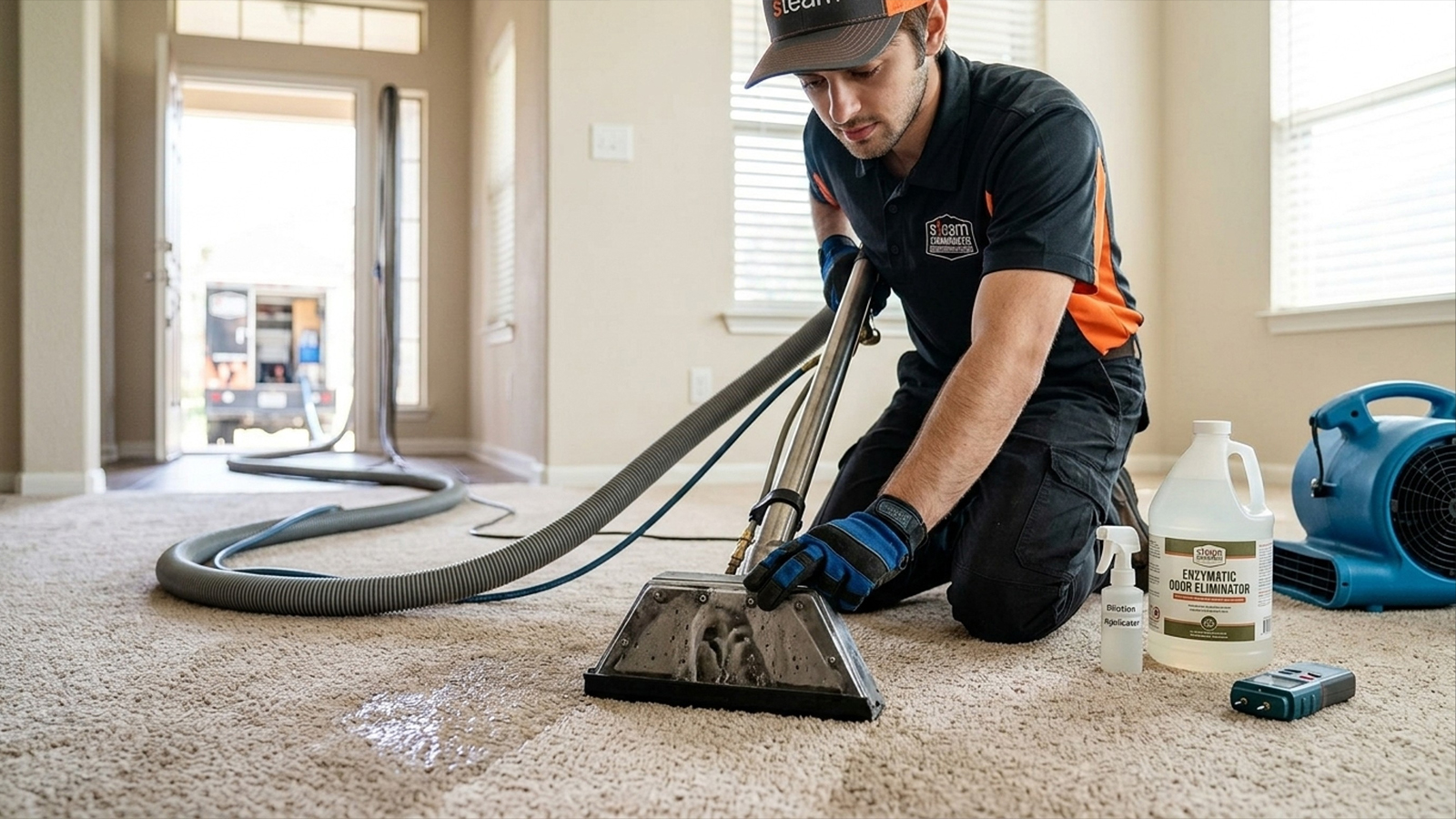
Only treatment that breaks down uric acid and proteins at pad depth lasts. Protease enzymes break down proteins, and urease and crystal-targeting enzyme blends handle the rest. True enzymatic odor eliminators such as Nature’s Miracle, Bubba’s, and Rocco & Roxie work differently than perfumed sprays. Baking soda and vinegar don’t break down uric acid, and they won’t lift a deep urine stain from the pad either.
The Seven-Step Source-Level Process
- Pre-inspection and mapping with UV and moisture readings.
- Pre-treatment of marked spots.
- Subsurface extraction to pull contaminated liquid out of the pad.
- Enzymatic saturation at pad depth with proper dwell time.
- Rinse extraction to remove loosened residue.
- Drying with air movers.
- Re-verification with UV and moisture readings.
Dwell time matters. Enzymes don’t work instantly, and results depend on full saturation. Hot water extraction (steam cleaning) is the method the IICRC S100 standard recognizes for professional carpet cleaning, and our hot water runs 150 to 230 degrees. The key is order: enzymes first, extraction after. That sequence settles the old argument about steam setting odor. Air movers matter too. In Houston humidity they dry the carpet fast so the crystals aren’t rewet.
DIY vs Professional Treatment at a Glance
| Factor | DIY enzyme spray and rental machine | Professional subsurface treatment |
| Typical cost | About $30 to $100 | Roughly $250 to $600 per room |
| Depth reached | Fibers, sometimes the upper pad | Pad and often subfloor |
| Verification | Smell test only | UV and moisture readings |
| Odds of lasting success | Low for older or large spots | Higher when the source is mapped |
A rental machine often over-wets the carpet without reaching the pad. That can make things worse. For one small, fresh accident, a true enzymatic product is a fair first try. For older spots or repeat problems, the table shows why going deeper saves money in the long run.
Do You Have to Replace the Carpet Pad, and How Do You Vet a Carpet Cleaner?
Not always. Replacement is the right call in some cases. Treating in place is better in others.
Do You Have to Replace the Carpet Pad? A Decision Checklist
Replace the pad when:
- The odor returns after a documented subsurface treatment.
- The pad is saturated, crumbling, or stained through.
- Urine has reached the plywood or concrete slab.
- The spots are large or very old.
Pad costs roughly $0.85 to $1.50 per square foot plus removal. Before new pad goes down, seal the subfloor with a stain-blocking primer such as Kilz Restoration so leftover urine can’t bleed up. Re-stretching the carpet comes after the new pad is in. If the pad passes inspection, treating in place saves money. An honest inspection should tell you which path fits your home, even when the answer is the cheaper one.
Questions to Ask Before You Hire a Carpet Cleaner for Pet Odor
After every storm, Houston fills with contractors who skip credentials. Texas has no statewide carpet-cleaning license, so verify any trade license a company claims through TDLR, and look for proof instead of promises. Ask any cleaning company:
- Is your technician an IICRC Certified Carpet Cleaning Technician (CCT)?
- Do you follow the IICRC S100 standard?
- Do you use subsurface extraction tools, not just surface passes?
- Will you show before and after UV and moisture readings?
- What are the written guarantee terms?
- Are you insured, and who is the named technician?
We hold ourselves to that list. Our 999 verified Google reviews average 4.9 stars, and you can see every reading we take. Feel free to hold any company to these questions, including us. A good one will answer them without hesitation.
Preventing a Repeat
Once the source is gone, keeping it gone is mostly speed and chemistry. Blot fresh accidents right away. Press straight down with a dry towel so the liquid doesn’t spread into the pad. Then treat the spot with a true enzymatic product, not a perfumed spray. Enzymes break down the uric acid. Fragrance only covers it, and pets can still smell what’s underneath.
That’s the part most people miss.
Pets go back to spots that still smell like urine, so a spot that was never fully neutralized gets marked again, and each layer adds more contamination. If a pet keeps returning to the same place after treatment, re-train the behavior along with cleaning the spot. Last, control indoor humidity with your HVAC or a dehumidifier. In a Cypress home, that’s what keeps the crystals dormant instead of waking up every muggy afternoon.
Conclusion
Pet odor comes back when the cause sits in the pad and the crystals, not the fibers. Treat the source and the smell can stay gone, even through a Cypress summer. If you want to know what is really under your floor, book a pet odor inspection with Steam Commander in Cypress, TX. We show you the UV and moisture readings on site, so you see exactly where the problem sits. If it’s easier to talk it through first, call (832) 813-2175 and we’ll help you figure out the next step.
FAQ
Why does my carpet still smell like pet urine after professional cleaning?
A carpet still smells like pet urine after cleaning when the urine sits in the pad or subfloor below the fibers. Surface cleaning removes the visible spot but leaves the source. Subsurface extraction and enzymatic treatment at pad depth, verified with readings, reach what a surface pass misses.
Why does pet urine smell worse when it’s humid or after cleaning?
Pet urine smells worse in humidity because moisture reactivates uric acid crystals. Wet cleaning can also wick salts up to the fiber tips, so the smell seems stronger right after. In Houston, humidity of 75 to 90 percent keeps waking the crystals. Thorough drying and re-verification prevent the cycle.
What neutralizes dog or cat urine odor in carpet permanently?
Enzymatic treatment neutralizes dog or cat urine odor when it reaches the pad with proper dwell time. Protease and related enzymes break down the proteins and crystals instead of covering them. Store sprays rarely reach that depth, which is why professional saturation and extraction work better.
Does steam cleaning set pet urine smell into carpet?
Steam cleaning can set pet urine smell when heat hits untreated urine, because heat bonds proteins to synthetic fibers. Hot water extraction is safe when enzymes go on first and extraction follows. The order of steps decides whether the smell lifts or locks in.
Do you have to replace the carpet pad to get rid of pet urine smell?
Replacing the carpet pad is needed only when documented treatment fails or the pad is saturated. Many pads can be saved with subsurface treatment. An inspection with UV and moisture readings tells you honestly whether to treat the pad or replace it.
How do I find old pet urine spots in carpet?
Find old pet urine spots with a 365nm UV blacklight in a fully dark room, where old urine glows yellow-green. Add moisture readings and a floor-level sniff test along edges. UV shows residue, not odor strength, so a professional mapping gives the full picture.