
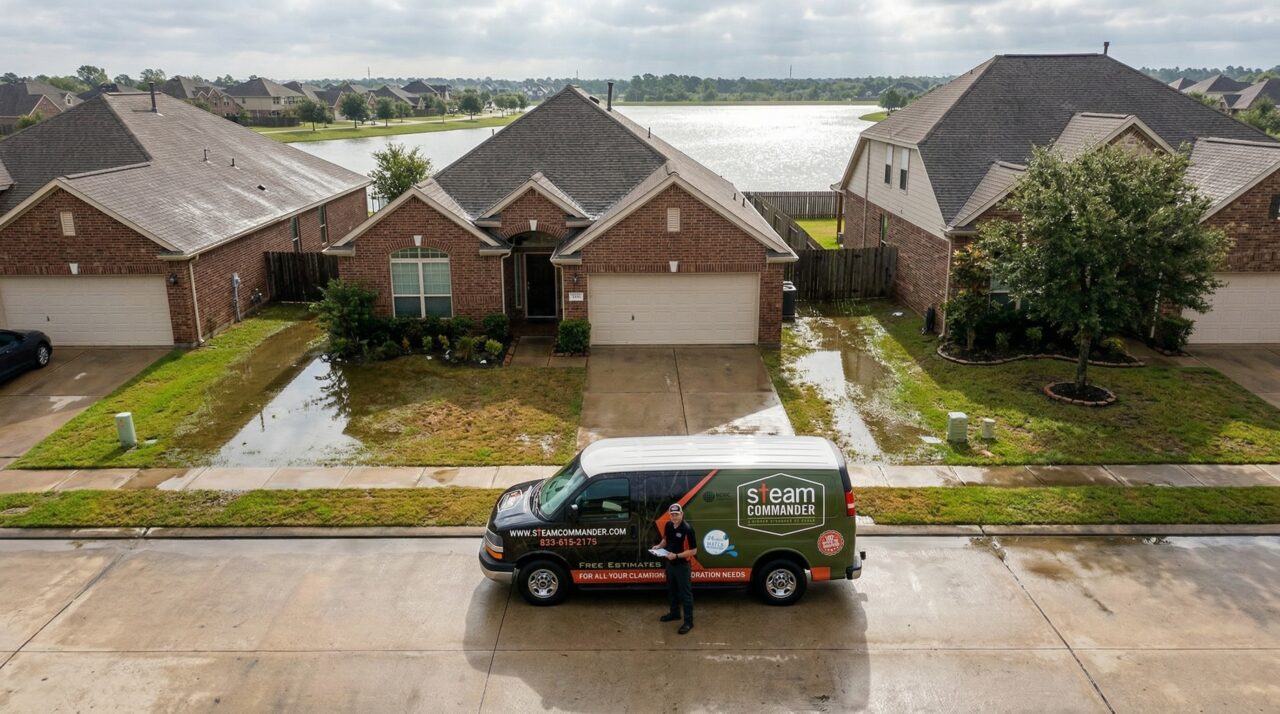
Towne Lake sits on 300 acres of water, surrounded by some of the most desirable homes in Cypress. But ask any experienced restoration professional working in this area, and they’ll tell you the same thing: living near water in the Cypress Creek watershed means water damage isn’t really a matter of if — it’s a matter of when, and how prepared you are when it happens.
If you’ve already found the problem — the wet carpet, the ceiling stain, the water pooling along the baseboard after last night’s storm — the decisions you make in the next few hours matter more than most homeowners realize.
Key Takeaways
- Mold can begin growing within 24 to 48 hours of water exposure — waiting even one day increases damage severity and remediation costs
- Cypress Creek flooding affects properties across Cypress, including many neighborhoods outside designated FEMA flood zones
- Standard homeowners insurance covers burst pipes and appliance failures — external flooding from creeks or street drainage requires a separate flood insurance policy
- Visible water is only part of the problem — moisture trapped in walls, subfloors, and insulation is where the real structural damage begins
- Steam Commander serves throughout Cypress and the Cy-Fair area, with the ability to reach most Cypress locations within 60 minutes for emergency calls
Why Cypress Homes Face a Unique Water Damage Risk
The Cypress Creek Watershed and What It Means for Your Neighborhood
Cypress is a beautiful place to live, and Towne Lake — built around the largest private lake in the Houston area at 300 acres and 14 miles of shoreline — is one of its most distinctive communities. That same geography that makes the area appealing creates well-documented exposure to water damage that homeowners in less flood-prone parts of TX simply don’t face.
Cypress Creek runs through the heart of northwest Houston. It has a long, documented history of rising quickly during heavy rainfall, and properties in the Cypress Creek watershed have experienced some of the most significant flood events in the region. During Hurricane Harvey in 2017, the Cypress Creek flood reached its highest recorded levels and damaged thousands of homes — 8,750 in the watershed at peak.
That kind of flooding doesn’t always require a hurricane. Serious Cypress Creek overflow events have produced significant damage in years before and after Harvey, affecting cypress properties that homeowners assumed were safe because they sat outside a designated FEMA flood zone.
The area around Towne Lake and surrounding neighborhoods sits on flat terrain underlaid by expansive clay soil. Clay holds water rather than absorbing it. It slows drainage and causes standing water to persist long after rainfall ends. It also expands and contracts with seasonal moisture changes, stressing the plumbing lines running beneath slab foundations — particularly in older Cypress homes with copper supply lines under the slab. A floor that feels inexplicably warm or a water bill that spikes without explanation are often early signs of this slow, invisible risk.
Storm damage is the other common entry point for water intrusion here. Hailstorms are routine across Harris County. A storm that compromises shingles may not produce visible leaking for weeks, until the next rainfall pushes water through the damaged roof deck and into the attic, where it saturates insulation and drywall long before a single drop appears on the ceiling below.
Learn More: Common Causes of Residential Water Damage
The Hidden Damage Homeowners Almost Always Miss
What’s Happening Behind Your Walls and Under Your Floors
The most dangerous assumption after a water event: it doesn’t look that bad. It almost never looks as bad as it is.
Water travels. It follows framing studs, seeps into insulation, wicks through drywall, and saturates subfloor panels well beyond the point of entry.
A wet patch on carpet that looks like a contained spill often means the pad is fully saturated, the subfloor beneath it is soaked, and the lower section of the surrounding wall cavity is holding moisture against wood framing.
Those are ideal conditions for mold and structural rot.
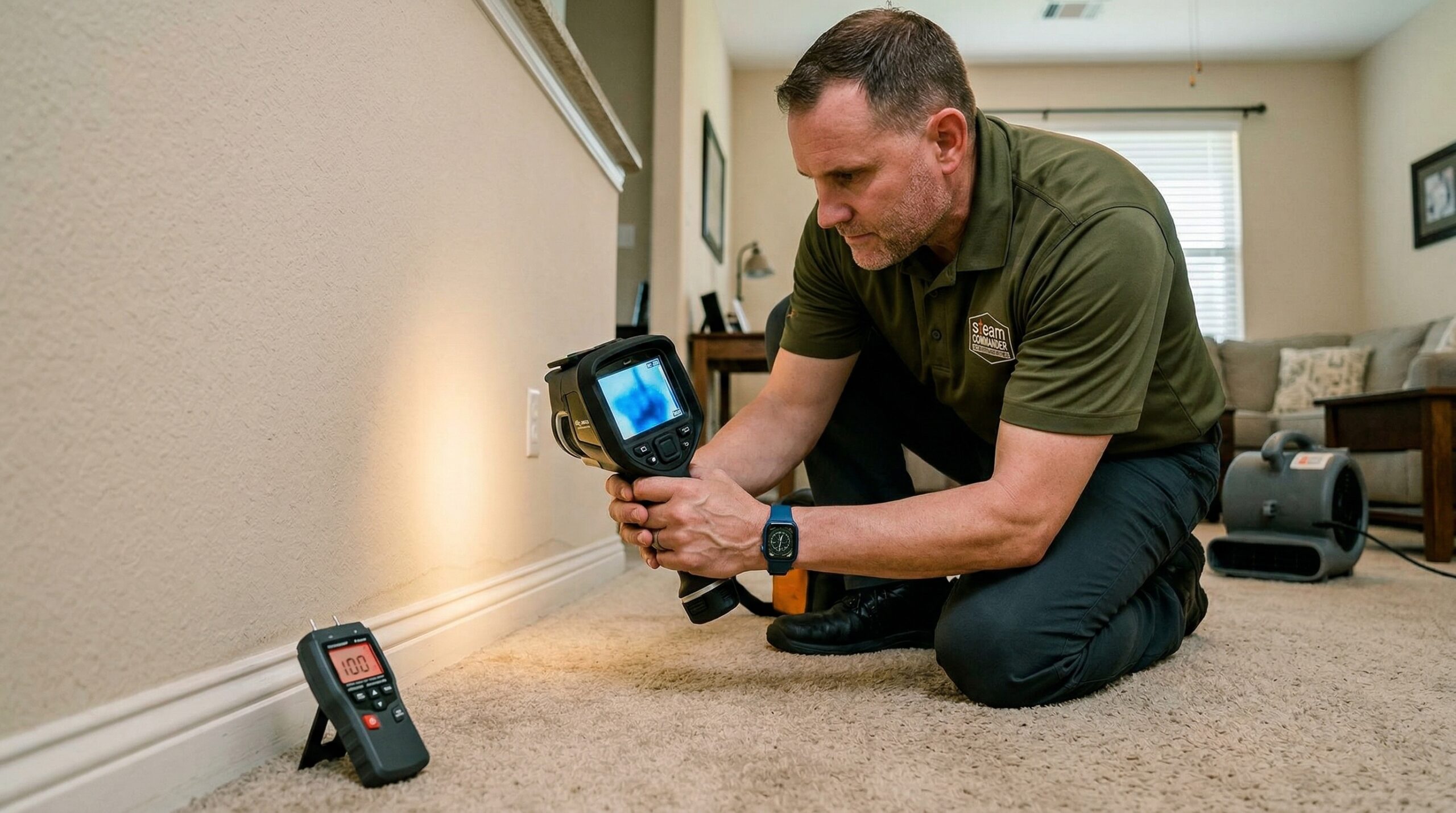
Hidden water is what restoration professionals spend most of their time locating. Thermal imaging cameras and calibrated moisture meters detect moisture in wall cavities and under flooring that is invisible to the eye and undetectable by touch.
Homeowners who run fans and assume the problem is resolved are often drying the surface while trapped moisture continues working inside the structure — and damage if left unaddressed compounds quickly.
The mold timeline is not theoretical. The U.S. EPA has documented that mold can begin growing on damp surfaces within 24 to 48 hours of water exposure. In Cypress, with Gulf Coast humidity averaging around 74% and temperatures above 60°F most of the year, that window can be even tighter — particularly in a newer cypress home near a body of water like Towne Lake, where ambient moisture levels run higher than average.
A persistent musty odor without visible mold almost always means active growth is occurring inside a wall, under flooring, or in the attic. By the time you can smell it, it’s established and spreading.
Structural damage compounds over time. Prolonged moisture in wood framing leads to rot, warping, and compromised load-bearing capacity. Water damage and create far more extensive repair costs than the original intrusion would have — what begins as a manageable water extraction job can become a structural repair project if action is delayed by even a few days.
Signs of hidden water damage in a Cypress home:
- Soft or spongy spots in flooring that weren’t there before
- Peeling paint or bubbling drywall
- Discoloration or staining on ceilings or walls — even faint yellowing matters
- A persistent musty odor you cannot locate
- Warping baseboards or door frames that suddenly stick
- Unexplained increases in indoor humidity
If any of these signs are present and you’re unsure what you’re dealing with, a professional moisture assessment answers the question quickly. Steam Commander offers free estimates and is available around the clock for Cypress homeowners who need a clear answer about damage and mold risk before committing to next steps.
What Professional Water Damage Cleanup Actually Involves
The Restoration Process Step by Step
Many homeowners delay calling a water damage restoration company because they picture something disruptive and unclear. The process is systematic. Understanding what happens in advance removes most of the uncertainty.
1. Assessment and moisture mapping. IICRC-certified technicians use thermal imaging cameras and moisture meters to assess the damage, mapping every affected area — including moisture that has migrated behind walls and under floors. This step defines the full scope and guides everything that follows.
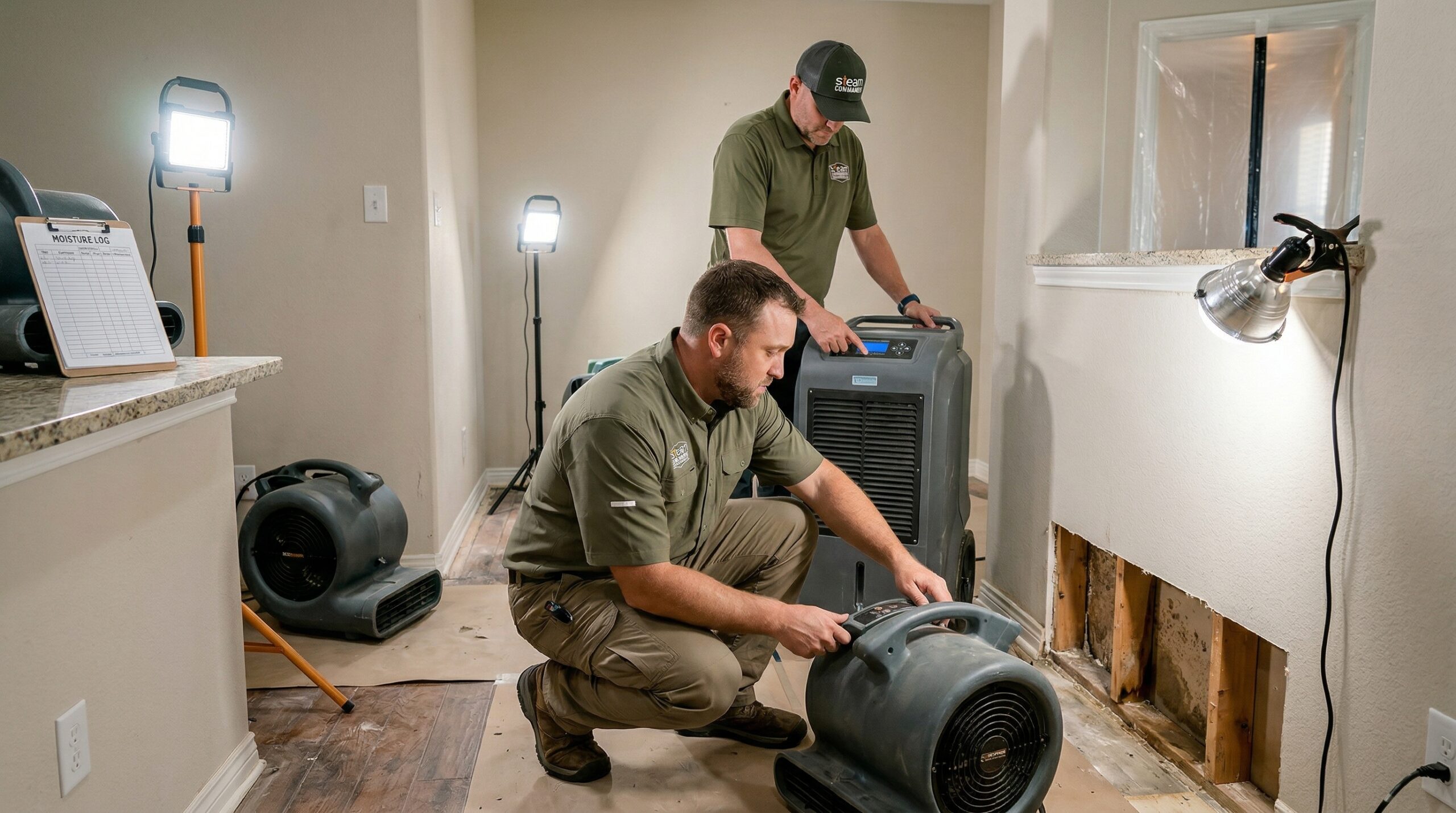
2. Water extraction. Industrial-grade equipment removes standing water and bulk moisture far more completely than any household wet-vac. For after-hours situations, emergency water removal service means this step happens immediately rather than the following morning. The goal is to remove standing water before it migrates further.
3. Structural drying. Commercial air movers and dehumidifiers run continuously — typically 3 to 5 days — pulling moisture from structural materials at the framing and subfloor level. Drying logs record moisture readings throughout. That documentation protects homeowners during insurance claims and in any future property transaction.
4. Mold remediation. When mold remediation is needed, it is addressed as part of the restoration process — treated surfaces, containment, and air scrubbing. Not as a surprise line item discovered later.
5. Repairs and restoration. Drywall, flooring, trim, and paint are restored to pre-loss condition. The cleanup and restoration process is complete when moisture readings confirm dry standard across every affected area.
| Restoration Stage | What Happens | Typical Timeframe |
|---|---|---|
| Assessment and moisture mapping | Thermal imaging, moisture meters, damage scoping | Day 1 |
| Water extraction | Industrial pumps and extraction equipment | Day 1 |
| Structural drying | Air movers, dehumidifiers, continuous drying logs | Days 1–5 |
| Mold remediation (if needed) | Treatment, containment, air scrubbing | Days 2–5 |
| Repairs and restoration | Drywall, flooring, paint, finishing | Days 5–10+ |
Steam Commander works directly with your insurance carrier from Day 1 — documenting every moisture reading and submitting directly to your adjuster. Dealing with water damage is stressful enough without also managing an insurance claim from scratch.

Insurance Coverage — What Cypress, TX Homeowners Need to Know
Insurance confusion is one of the most common reasons homeowners delay calling for help after water damage in cypress. The framework is straightforward once you understand the one distinction that matters most.
Standard Texas homeowners insurance — the HO-3 policy most residents carry — covers sudden and accidental water damage. Water damage from burst pipes, appliance failures, and roof leaks caused by a covered storm event are generally included. Water from sewage backups may or may not be covered depending on your specific endorsements; that’s worth confirming with your agent before a loss occurs.
What HO-3 does not cover is external flooding. Water that enters from the ground, from Cypress Creek overflow, or from street drainage during a storm requires a separate flood insurance policy through the NFIP or a private carrier. Many cypress homeowners near Towne Lake and the Cypress Creek watershed carry no flood policy because they fall outside a FEMA flood zone. The documented history of flood damage in this area tells a different story about the actual risk.
One practical detail that matters more than most homeowners expect: the language used when filing a claim affects outcomes. Calling a burst pipe failure a “flood” can trigger an incorrect coverage category and complicate or delay your claim. Water damage restoration specialists who document damage correctly from the moment they arrive protect your claim before the adjuster ever sees the file. That’s a service that pays for itself.
Typically covered under standard homeowners insurance (TX HO-3):
- Burst pipe or sudden plumbing failure
- Appliance overflow (washing machine, dishwasher, water heater)
- Roof leak caused by wind or hail damage during a storm
Typically requires separate flood insurance:
- Cypress Creek overflow entering the home
- Rising groundwater or storm surge
- Street drainage backing up through the foundation or ground-level openings
Why Local Expertise Matters for Water Damage Restoration in Cypress
Serving Cypress Homes and Businesses Across the Cy-Fair Area
When water damage strikes your Cypress home, response time is the variable that most directly affects total cost and the likelihood of secondary damage. The documentation practices that protect your insurance claim also start at that first call — which is one more reason that who you call, and how quickly they arrive, matters beyond the initial water removal.
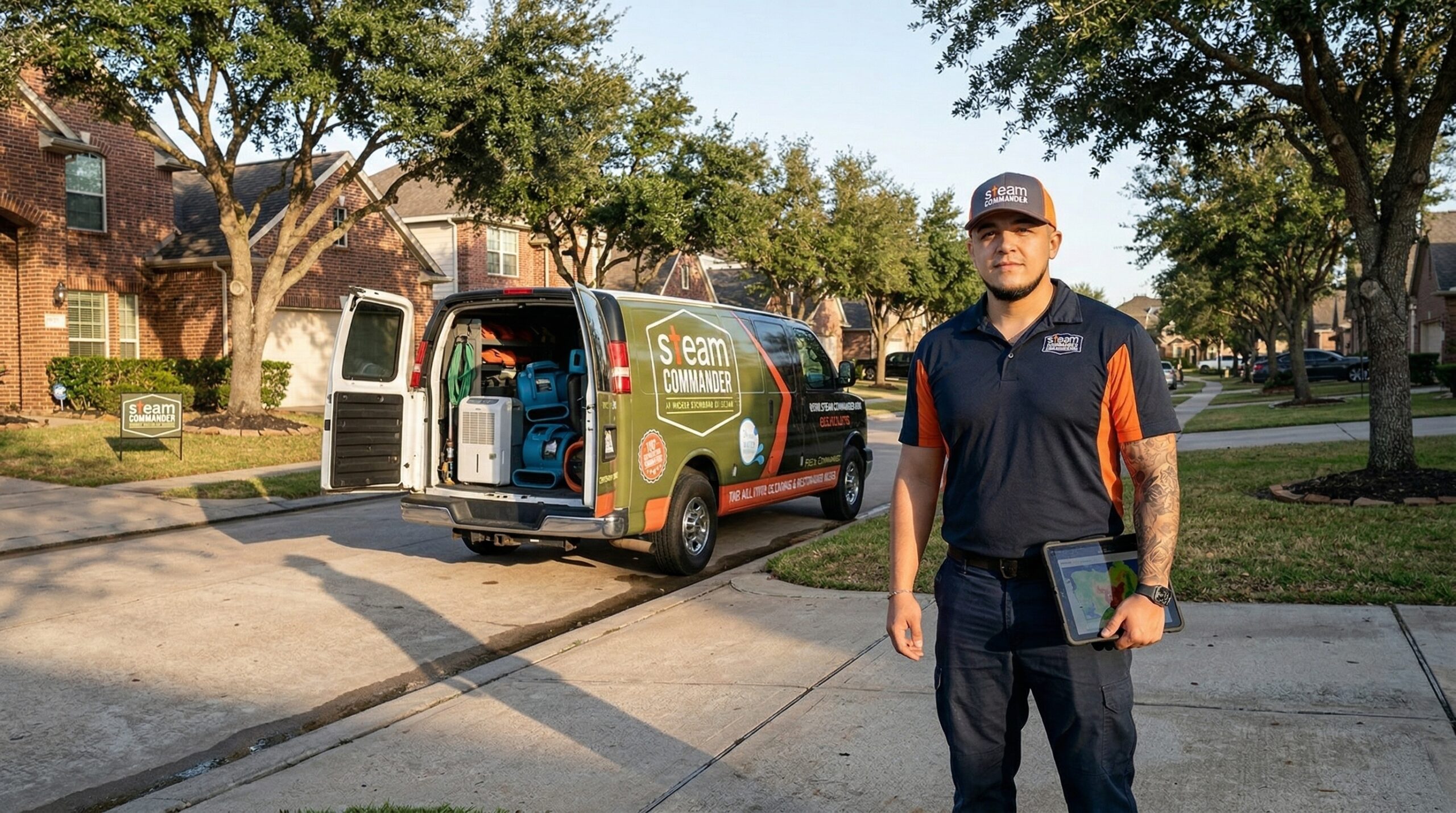
Steam Commander provides damage restoration cypress TX homeowners can count on, with the ability to reach most Cypress locations within 60 minutes for emergency calls — day or night, weekends and holidays included. That response comes from a local team that knows Cypress Creek, understands the drainage patterns around Towne Lake and Cypress Creek Lakes, and has direct experience with the types of water damage most common across Cypress properties. Not a national dispatch center routing a crew from across the region.
That local familiarity carries real weight. The tight construction common in Towne Lake’s newer homes holds moisture in wall cavities differently than older builds, and water damage restoration specialists who regularly work in Cypress homes recognize that quickly. Many homes in master-planned communities across cypress also operate under HOA guidelines and architectural review standards that govern reconstruction work. Experienced restoration teams navigate those requirements without creating additional complications for the homeowner.
Steam Commander handles everything from water damage restoration to complete property damage restoration — serving both residential and commercial properties throughout Cypress:
- Emergency water damage restoration and water removal
- Complete water extraction and structural drying
- Mold remediation and air quality treatment
- Fire damage restoration and smoke damage cleanup — because fire and smoke damage often involves water damage from suppression efforts
- Storm damage restoration from roof intrusion, wind, and hail
- Flood damage cleanup for residential and commercial properties throughout Cypress
Steam Commander serves all Cypress communities — Towne Lake, Cypress Creek Lakes, Fairfield, Bridgeland, Coles Crossing — and throughout Cypress and surrounding areas. Whether you’re a homeowner near the Towne Lake waterfront or a business owner dealing with water damage in cypress after a pipe failure, the response capability is the same.
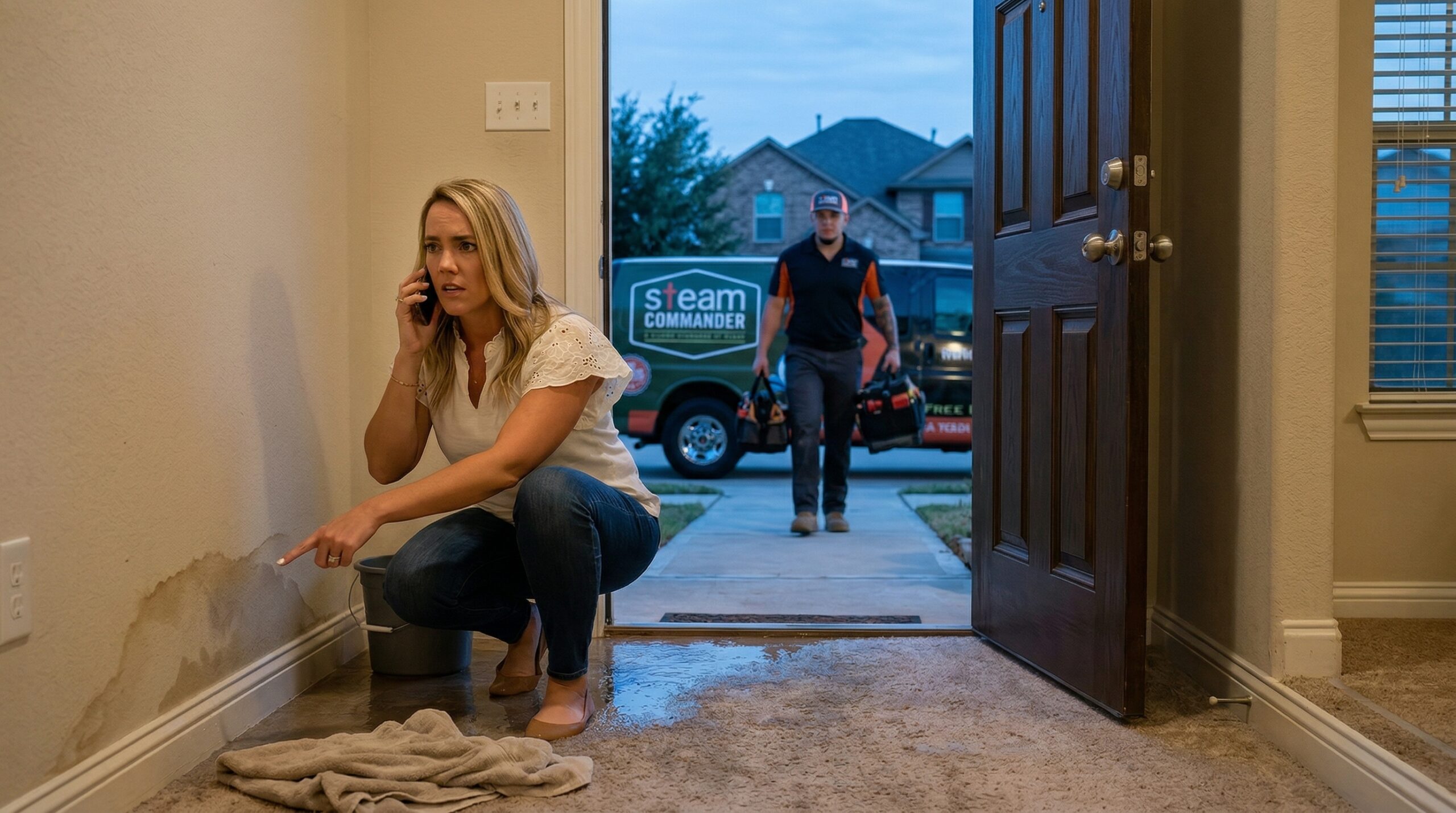
What To Do Right Now If You’ve Found Water Damage
Found water damage in your home? Whether it’s a small leak, significant standing water, or a ceiling stain you can’t explain, here are the immediate steps to take before professional help arrives.
Do this first:
- Turn off the water source if you can safely reach the shutoff valve or main line
- Cut power to the affected rooms at the breaker panel if water is near electrical outlets or appliances
- Document everything with photos and video before moving or drying anything — that record matters for your insurance claim
- Remove standing water with towels or a household wet-vac if the volume is small and safe to approach
- Call a professional the same day — do not wait overnight to see if it clears up on its own
Do not:
- Use a standard household vacuum on standing water
- Close wet rooms and assume they will dry naturally — trapped air without dehumidification accelerates mold growth
- Run ceiling fans over wet areas — this distributes moisture and potential mold spores through the room
- Delay calling if there is any sign of sewage involvement or gray/black water — that situation requires professional equipment and disposal protocols for health and safety
If you’re in Cypress and unsure whether what you’re seeing warrants a call, call anyway. Steam Commander can be reached at (832) 813-2175 for emergency water damage response across the Cy-Fair area, and a quick assessment costs nothing.
Conclusion: Facing Water Damage Near Towne Lake? Here’s the Bottom Line
Water damage near Towne Lake is a known, recurring risk — not a freak event. The geography, the clay soil, the Cypress Creek flood history, and the Gulf Coast climate all point in the same direction. Cypress homeowners who come through it with the least damage are almost always the ones who called a professional the same day rather than waiting to see what dried on its own.
Extensive water damage almost always starts as something that looked minor — a ceiling stain, a small wet patch, a musty smell that appeared after a storm. The 24 to 48 hour mold window is real, and in this climate, it moves fast.
Steam Commander provides trusted water damage restoration services throughout Cypress and the Cy-Fair area — from emergency water removal and structural drying to mold remediation, repairs, and direct insurance coordination. Residents of Cypress don’t have to navigate this alone. If water damage has struck your Cypress home or you’ve noticed something you can’t explain, a free professional assessment from a local, IICRC-certified team is the right place to start. Most Cypress locations are reachable within 60 minutes. Call (832) 813-2175 any time.
FAQ
How quickly can mold develop after water damage in a Cypress home?
According to the U.S. EPA, mold can begin growing on damp surfaces within 24 to 48 hours after water exposure. In Cypress, the Gulf Coast climate — persistent humidity, warm temperatures across most of the year, and the elevated ambient moisture near communities like Towne Lake — can compress that window further. Visible mold is often a sign that growth has already been underway for days inside walls or under flooring. Same-day professional response is the most effective way to stay ahead of secondary damage and remediation costs.
Does my homeowners insurance cover water damage from Cypress Creek flooding?
Standard Texas HO-3 homeowners insurance covers sudden and accidental internal water damage — burst pipes, appliance failures, and roof leaks from covered storm events. It does not cover external flooding, including Cypress Creek overflow, rising groundwater, or storm surge. That protection requires a separate flood insurance policy through the NFIP or a private carrier. Many Cypress homeowners outside FEMA flood zones carry no flood policy and are caught off guard after a major rain event. Confirm your coverage with your agent before a loss, not after.
Can I handle water damage cleanup myself?
For very small, contained spills on non-porous surfaces, basic cleanup is manageable. For anything involving carpet, subfloor, drywall, or wall cavities in a Cypress home, professional equipment is the practical choice — not because the process is complicated, but because there is no accurate way to confirm that structural materials have returned to dry standard without calibrated moisture meters. Fans and towels address surface moisture. They do not dry framing. And any damage cleanup involving gray or black water, sewage backflow, or storm-driven flooding requires professional protective equipment and proper disposal — full stop.
What are the signs that water damage is worse than it looks?
Watch for a persistent musty odor without visible mold, soft or spongy spots in flooring, staining or bubbling on walls or ceilings, door frames that stick or no longer close, and peeling paint in areas that were never applied over a wet surface. Any of these signs in a Cypress home after a storm, leak, or appliance failure should be evaluated with moisture meters. Hidden water damage is the norm in serious cases, not the exception — and a professional assessment removes the guesswork before the damage and mold situation escalates.
How long does professional water damage restoration take?
Most residential projects involving structural drying take 3 to 5 days for the drying phase, with repairs and restoration following over the next several days to two weeks depending on scope. The drying phase cannot be safely shortened. Moisture readings are logged throughout to confirm that structural materials have returned to dry standard before reconstruction begins. Closing walls before that confirmation is how Cypress homeowners end up with mold remediation claims a year after what looked like a clean repair.
Does Steam Commander serve areas outside Towne Lake in Cypress?
Steam Commander provides water damage restoration in Cypress and surrounding communities throughout the Cy-Fair area — including Cypress Creek Lakes, Fairfield, Bridgeland, Coles Crossing, and across cypress and the cy-fair area more broadly. The team can reach most Cypress locations within 60 minutes for emergency calls, serving cypress homes and businesses and commercial properties throughout Cypress. If you have questions about water damage at a residential or commercial property, call (832) 813-2175 to confirm service availability and get a same-day response.